
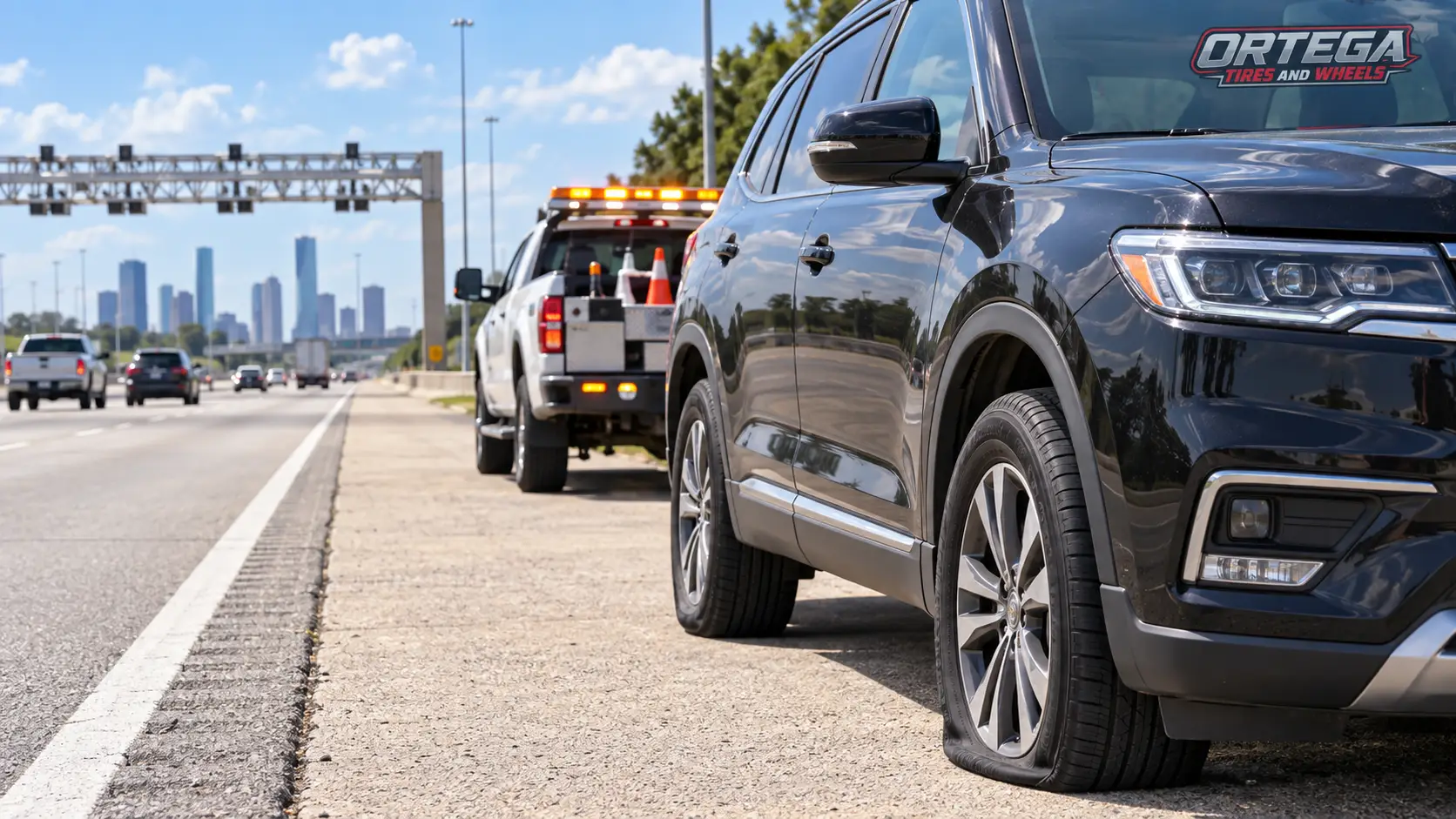
Know who to call, stay safe, and get your damaged tire checked.
You are heading home when the steering feels different. Then comes the thumping sound. A flat tire is frustrating anywhere, but on a busy toll road, with vehicles passing a few feet away, it can quickly become overwhelming.
Fortunately, Harris County drivers have access to free roadside assistance through the Harris County Toll Road Authority, or HCTRA. Knowing how to request help can make an already stressful situation easier to manage.
Here is what to do, what assistance is available, and why getting your spare installed should be followed by a professional tire inspection.
How to Request Free Roadside Assistance
Call HCTRA’s Incident Response Team at 281-584-7500. HCTRA advertises free roadside assistance on its toll roads seven days a week, from 5 a.m. to midnight. Save the number in your phone before you need it. HCTRA’s service announcement confirms the number and hours.
Once safely stopped, be ready to provide:
- The toll road name and your direction of travel.
- The nearest exit, cross street, or mile marker.
- Your vehicle’s make, model, and color.
- Whether you are on a shoulder or blocking a lane.
- What happened and whether you have a usable spare.
Account holders can also access a roadside assistance calling feature through the EZ TAG app, according to HCTRA’s official app listing.
This service covers Harris County-operated toll roads. Do not assume every Houston-area toll road has the same operator or coverage. Describe your location to dispatch if you are unsure.
Call 911 for injuries, fire, immediate danger, or a vehicle stranded in an active traffic lane.
What Help Is Available?
HCTRA identifies flat tires, empty fuel tanks, jump-starts, and tows among the situations its Incident Response Team handles. That means a flat tire or dead battery does not automatically leave you arranging help alone. HCTRA’s roadside assistance overview describes these services.
For a flat, tell dispatch whether your vehicle has a spare and whether you have the wheel-lock key, if needed. If the spare is missing, flat, or unusable, explain that when calling.
Ask dispatch what assistance is possible and whether towing is needed. Confirm the destination and any charges for additional towing before agreeing to arrangements. Do not assume free roadside assistance includes transportation all the way to your preferred repair shop.
The roadside goal is to address the immediate breakdown and help you reach safety. A permanent tire repair requires a separate assessment.
Get Safely Out of Traffic
If a tire suddenly loses pressure, resist the urge to slam on the brakes. Hold the steering wheel firmly, gradually ease off the accelerator, and stabilize the vehicle before slowing further and pulling off where safe.
These steps follow NHTSA’s tire blowout guidance. The agency reports 511 traffic deaths in tire-related crashes in 2024, underscoring why maintaining control matters.
Turn on your hazard lights and move as far from moving traffic as conditions safely allow. Avoid abrupt lane changes or trying to reach a distant exit on a flat tire.
Once stopped, put the vehicle in park and apply the parking brake. Getting everyone out of immediate danger takes priority over protecting the tire or wheel.
Stay Safe While Waiting
A toll road shoulder is no place to rush through a tire change beside passing traffic.
If your vehicle is safely clear of traffic and there is no immediate threat, remain inside with seat belts fastened. Keep children and pets secured. MoDOT’s roadside safety guidance emphasizes staying protected inside the vehicle with hazards flashing.
If fire, smoke, or another immediate hazard makes staying inside unsafe, exit away from traffic if possible and move to a protected location. Follow the dispatcher’s instructions.
Avoid standing beside the traffic-facing doors, between vehicles, or directly in front of or behind your car. Do not walk into a travel lane to retrieve debris.
Keep your phone available for the response team. Photographs, insurance messages, and calls about being late can wait until everyone is secure.
Have the Damaged Tire Inspected Promptly
Once roadside assistance gets you moving, arrange an inspection as soon as practical. A temporary spare is for limited emergency use; follow its label and your owner’s manual for speed and distance restrictions.
Do not drive on the damaged tire simply because it accepts air again.
Michelin’s tire experts warn that “A tire that looks normal after hitting a pothole may have structural damage that will eventually fail.” Its tire damage guide explains why an internal inspection can reveal problems that an outside glance misses.
Tell Ortega Tires and Wheels whether you drove on the flat, hit a pothole, noticed vibration, or used tire sealant. Those details help guide the inspection.
Can the Tire Be Repaired?
Some punctures are repairable, but location, size, and internal condition matter.
The U.S. Tire Manufacturers Association’s repair guidelines limit eligible punctures to the repairable tread area and no more than ¼ inch, or 6 millimeters, in diameter. Damage extending into the shoulder or sidewall is outside those repair limits.
USTMA’s experts state plainly: “A plug alone is an unacceptable repair.” Proper repair requires removing the tire, inspecting it internally, filling the injury, and sealing the inner liner.
Manufacturer restrictions also apply. Having plenty of tread does not guarantee a damaged tire can safely return to service.
Get Back on the Road With Confidence
Before your next trip, check your spare and tire pressure. NHTSA says proper inflation can extend average tire life by 4,700 miles and recommends checking all tires monthly when cold. Use the vehicle’s recommended pressure. Read NHTSA’s maintenance advice.
After a toll road flat, contact Ortega Tires and Wheels in Spring, TX, for an inspection and help determining whether repair or replacement is appropriate. If your vehicle cannot safely reach the shop, arrange towing.
Save 281-584-7500 today. When an unexpected flat interrupts your drive, knowing who to call gives you one less thing to worry about.
Leave a Reply